Sunday, August 15, 2010

Century Logistic

Century closed at 1.72 with an upside gap last Friday. This gap is a reflection of eagerness in buying. Strong resistance is likely to emerge at 1.73. A good entry point to enter is at 1.62. That's where the gap broke out. Be patient, wait for the gap to close. However, should 1.73 be breached convincingly, chase the stock.
Fundamentally, the company has done extremely well. The latest two quarters showed tremendous growth. Click here for more info.

Saturday, August 14, 2010

What triggers you to buy a stock?

Is it a hot tip, strong growth in revenue and earnings, an analyst's recommendation or some bullish news pertaining to potential mergers and acquisitions? For most people, a hot tip is probably the answer. Do you know why is it called a hot tip? Occasionally, a hot tip enables you to make some quick money. But most often it lands you in some hot soup. The tip is hot because it can burn your fingers. So, what should you do when you hear a hot tip? For me, it means a quick look at the chart, and then to do a due diligence on the company. This means looking at the fundamentals of the company. If the chart is in accord with the fundamentals, I will buy. If not, I will avoid.


What, if the chart is bullish, but the stock is not solid? In that case I may put in a small bet with a cut-loss in place. This is to ensure that I can quit with a small loss when the trend goes against me. How about, when the chart is flat, but the stock is undervalued? In this case, I will keep an eye on the stock, wait until the chart shows a buy signal and then buy. Does this make sense to you?


Different people buy equities for different reasons. For some it is for capital gains while for others it is more for the dividends. One reason that applies to all is that the shares are bought for sale later, hopefully, for a profit. Thus when you buy a share, it behooves you to ask yourself whether you can make profit buying the shares. If you answer is: Sure. Well and good. But if your answer is: Maybe. Then you should bet only what you can comfortably lose.


Opportunities neglected seldom return. An excellent opportunity is difficult to come by. When you happen to meet one, make the best use of it; put in a sizable bet. This is what wisdom is all about.


What is a sizable bet? This is subjective. To some 500,000 is a small bet, while to others 50,000 is too much. You should know your own.


Friday, August 13, 2010

Report a Fraud or Get Help

If you have any information pertaining to illegal financial schemes, or are a victim of such schemes and want to seek advice, you can directly contact Customer Service Centres:

BNMTELELINK (Call Centre)

  • Tel.: 1-300-88-5465 (1-300-88-LINK)
    Fax: 03-2174 1515
    SMS to 15888: BNM TANYA [your report / query]
    Email: bnmtelelink@bnm.gov.my

    Operating Hours: 9.00 a.m. - 5.00 p.m. (Monday - Friday)

BNMLINK (Walk-in Centre)

  • Ground Floor, D Block,
    Bank Negara Malaysia,
    Jalan Dato' Onn
    50480 Kuala Lumpur

    Operating Hours: 9.00 a.m. - 5.00 p.m. (Monday - Friday)

Thursday, August 12, 2010

It's Time to Start Trading Currencies

Are you feeling left out of the forex action? After all, the forex market is a fast pace action market that is open 24 hours a day / 5 days a week. What excites most new forex traders and experienced is the volatility the market provides; it’s a non-stop reactive market. Forex has become ever popular since the stock and commodity markets took a dip in recession; which gave forex trading a popular edge. The Forex market consist of multiple currencies but there only four major ones that you should stick with; Euro (which is made of 27 member states), Sterling (which is also commonly referred to the British Pound), U.S Dollar, and the Japanese Yen. The reason why these four currencies hold larger weight then the others, it’s because they are globally liquidated and are traded by over 80% percent plus of the forex traders. However, in order to be a long-term successful forex trader you need to be disciplined and have an all-inclusive strategy. The critical points that will separate a long-term forex trader from others would be fundamental analysis, technical analysis, and candlesticks.

Fundamental analysis is the study of the news outcome. In the forex market, the economic news is an on-going and overlapping at times. Not all economic news hold the same weight; some are more important then others. It is very important to follow the news of the currency you are trading; if you are trading U.S dollar against the Euro then it would be wise to watch the U.S economic indicators and the large stake economic players in the European Union (France, Germany, and United Kingdom). For example, if the U.S unemployment rate comes out better then forecasted it would give the U.S dollar a boost against all other major currencies but if unemployment rate climbs more then expected; it would create a negative rippling effect on the forex traders and they will start selling off there current positions (which would downtrend the U.S dollar against other currencies). News outcomes that hold little or no weight consist of the micro-economic picture of the overall country, for example, natural gas storage, construction spending, and total vehicle sales; don’t hold a significant role in shaping the U.S dollar outlook. All major currencies react to both the positive and negative news sentiment. The importance of the forex news indicators have changed over the years; if you are planning to enter the forex market it will be best to keep an eye out for the unemployment news, NFP (Non-farm employment), retail sales, and the Federal fund rate. Previously, the unemployment news had no role in the forex market but ever since the global recession has started, its role has increase and it is expected to hold its position for the next few years.

The most liquidated forex currency to trade would be the EUR USD, since it has the largest margin of traders, liquidation, largest financial institutions in the world (Banks, Investment firms, etc.), and it’s trend is based on cause and effect.

Technical analysis is the ability to determine the forex trader’s sentiment. Forex charting is very important to stay on pace with the forex traders mind-set. If you are looking to become a profitable forex trader it is extremely important to understand trend and resistance lines. To find the trend you need to ask yourself this question, is the currency moving from the top left corner to the bottom right (downtrend) or is the currency moving from the bottom left corner to the top right (uptrend)? There are three important reasons to follow the trend in the forex market because it will be your “best friend”.

(1) The trend gives you the overall sentiment of the traders (buyers or sellers).

(2) They are persistent and have long-term duration.

(3) Trends have a tendency of not breaking easily without a cause and effect (economic news, political event, etc.)

The next important fact about technical analysis is ability to determine where the resistance lines are. Resistance lines are the price action points on the chart of where the buyers decided to sell there position’s (high point) and where the buyers decided to re-enter the market (low point). In the forex market, currencies strength is measured by the ability to break the previous high or low; which makes increases the trader’s confidence of the currency to execute his or her trade. Every currency pair, will usually have three to five resistance lines that are symbolic to the trader’s strategy. In an uptrend, the forex trader is waiting for the currency to break the next resistance line to give him the confidence of pulling the trigger and executing his trade and vice-versa in a downtrend; the trader is waiting for the currency to break the next low resistance line to enter a sell position.

It is best to have your forex chart be set on the (Japanese) candlestick model because candlesticks are excellent at picking up extensive information. Candlestick will inform you of the overall market sentiment (green is bullish and red is bearish), a candlestick with long line trail is consistent with the buyers or sellers executing there position and leaving the market … so you know that the currency is direction bias has increased, currency reversals, and the visual cues it provides makes forex trading much more easier to deal with.

(This article is a contribution from Martin Short of Forextraders.com)

Should You Store Gold Offshore?


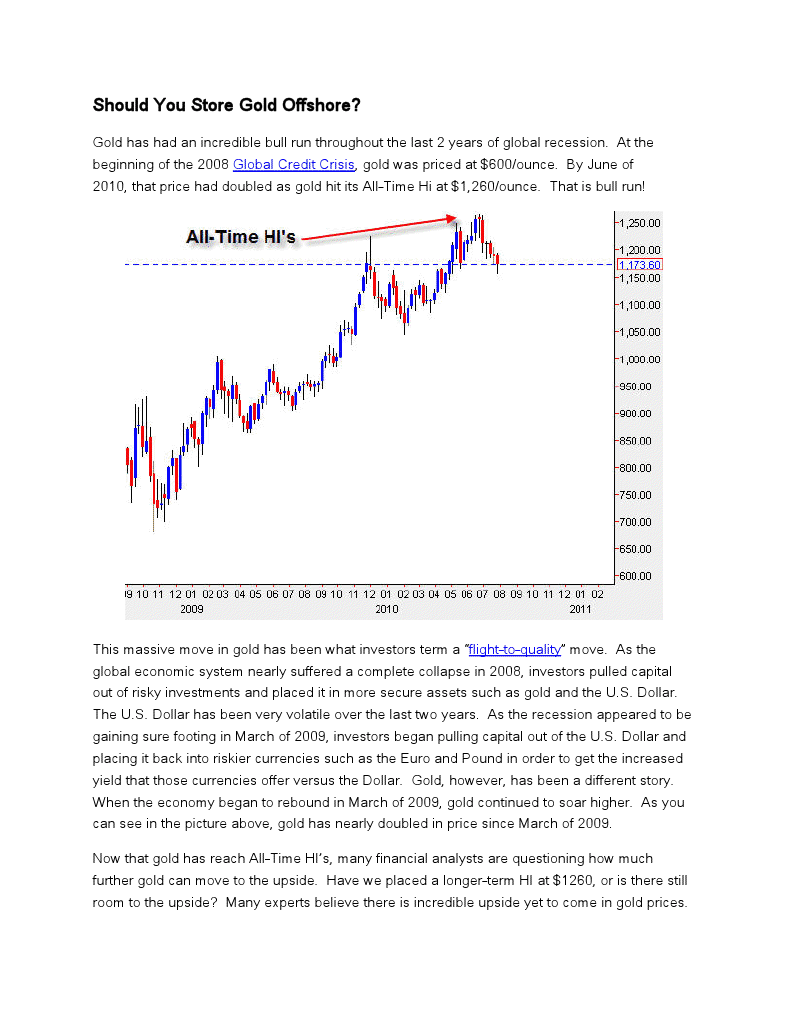
Gold has had an incredible bull run throughout the last 2 years of global recession. At the beginning of the 2008 Global Credit Crisis, gold was priced at $600/ounce. By June of 2010, that price had doubled as gold hit its All-Time Hi at $1,260/ounce. That is bull run!

Your browser may not support display of this image.

This massive move in gold has been what investors term a “flight-to-quality” move. As the global economic system nearly suffered a complete collapse in 2008, investors pulled capital out of risky investments and placed it in more secure assets such as gold and the U.S. Dollar. The U.S. Dollar has been very volatile over the last two years. As the recession appeared to be gaining sure footing in March of 2009, investors began pulling capital out of the U.S. Dollar and placing it back into riskier currencies such as the Euro and Pound in order to get the increased yield that those currencies offer versus the Dollar. Gold, however, has been a different story. When the economy began to rebound in March of 2009, gold continued to soar higher. As you can see in the picture above, gold has nearly doubled in price since March of 2009.

Now that gold has reach All-Time HI’s, many financial analysts are questioning how much further gold can move to the upside. Have we placed a longer-term HI at $1260, or is there still room to the upside? Many experts believe there is incredible upside yet to come in gold prices. The fundamental reasoning is simple. A strong mistrust in fiat currencies is growing among the investment community.

A fiat currency is a currency that is not backed by any physical commodity. For example, in decades past, a person used to be able to exchange his $10 bill for $10 worth gold, but today that gold standard does not exist. Therefore, that $10 bill is only backed by the government that issues it, and this is the reason that investors are growing increasingly weary of fiat currency. During the economic crisis of the last two years, the U.S. government, and other governments around the world, has printed historically unprecedented amounts of money. Many experts argue that at some point in the future, this massive supply of U.S. Dollars in the world economy will cause rapid inflation which will devalue the U.S. Dollar significantly. The alternative is to hold gold. Gold is commonly thought of as an investment that will not lose value over the long term. When fiat currencies begin to fail and even be destroyed, gold will continue to hold value. Thus, many investors are continuing to turn to gold as a safe-haven investment. In the rest of this article we will address two things:

      1. Is it safe to store gold offshore?
      2. Is there a way to profit off an increase in gold and in a fiat currency?

Many experts suggest evenly distributing one’s gold assets among various locations. The reason is because if an economic meltdown does occur, and an investor has all of his gold in a particular safe-deposit box at a bank, he may not be able to get that gold out right away, or in the worst case scenario, ever. Thus, it is safe to diversify by placing gold in several locations, and one strategy includes storing some gold offshore. Where should one store gold offshore? Well, this ties in with the second question we will address. Is there a way to profit off an increase in gold prices and a fiat currency?

The short answer, possibly, is yes. Let’s assume that the U.S. Dollar is going to decrease in value over the long-term. Many economists are predicting this to happen. If the U.S. Dollar is going to decrease in value over the long term, it may be wise for an investor to purchase gold in a currency that is expected to increase over the long-term. One such example would be the New Zealand Dollar. The New Zealand Dollar tends to have one of the highest interest rates among developed nations.

One way that investors profit from this high interest rate in New Zealand is by taking U.S. Dollars, which carry an interest rate of basically 0% and putting that money into the New Zealand Dollar, which currently offers an interest rate of 3%. So, an investor is now earning 3% on his money with very little to no risk; however, he is subject to the volatile currency swings the forex news events can cause. As a rule of thumb, over the long term, a higher yielding currency should appreciate versus a lower yielding currency. Thus, by purchasing gold in New Zealand, an investor will expose his capital to a higher yielding currency, possibly profit from an increase in the exchange rate, and profit from the possible increase in gold prices. Not a bad deal!! Thus, buying and storing gold offshore in New Zealand, may be a wise alternative for investors.

(This article is a contribution from Martin Short of Forextraders.com)

The Stock Market Is In Limbo—Which Way Will It Go?

An incredibly positive corporate earnings season in July has helped the market to discount immediate fears of a possible double dip recession. The strong corporate earnings reports, however, had to battle Ben Bernanke’s very dovish remarks, as he emphasized the slowing recovery in the U.S. and raised the possibility of Federal Reserve instituting further quantitative easing measures. Those bearish remarks by the Fed President regarding the possible future direction of the U.S. economy did cause equity markets to stall in the 3rd week of July, but now in the final week of the month, equity markets are again taking a shot at the HI’s from the month of June.

As the Dow Jones creeps higher it is going to face a tough test at the 10,600 level. This is the area where price reacted with a violent failure in June. Currently on the Daily Chart in the Dow Jones, we are looking rather bullish. Price moved from the lows of 9,600 in early July to a HI at 10,400 before it began a corrective move down to 10,000. Since hitting 10,000 last week, the Dow has been moving higher and we appear to now have a higher HI in place on the Daily Chart, which generally is a sign of continued bullish movement.

Where Is the Market Headed?

In Chairman Bernanke’s testimony before Congress, he made it clear that the economic recovery in the U.S. was slowing. Now, the market’s attention is going to be on U.S. economic data in order to help discern how bad the slowdown will be. First of all, investors must understand that a slowdown is okay. In fact, after the rapid rebound from the lows of March 2009, the global economy is due for a small slowdown. What we don’t want to see, however, is a contraction in growth. Slow growth is okay, while contraction is very dangerous. If economic data begins to show economic contraction, then the threat of a double-dip recession could become very realistic, and the market would have a very difficult time moving higher.

However, if economic data coming out during the next few weeks shows that the U.S. economic recovery is still moving forward, then we should see further gains in the equity markets. All attention is currently set on the Advanced GDP figure that will be released on Friday July 30th. The figure is expected to come out at 2.5%, which is slightly lower than the previous quarter. The lower projection is in line with Bernanke’s remarks concerning a slowdown in the economic recovery. If this number comes out lower than 2.5%, it could mean very big trouble for the U.S. equity markets. If the number comes out 2.25% or less, expect a large sell-off in the U.S. equity markets. If could get very ugly.

Currently, Mervyn King in the England and Ben Bernanke are both warning of very difficult times in the near future for the global recovery. Jean-Claude Trichet at the European Central Bank, however, is not as dovish as these other two. The fact that we have two of the three most powerful economic and financial leaders in the developed world very bearish on the global economic recovery is not a very good sign for the U.S. equity markets. Although the markets are fighting to move higher at the moment, it could all change very quickly if U.S. economic data begins to surprise to the downside. Market participants are fully aware that the recovery is slowing, and as we stated earlier, that is okay. The problem is going to be when the data begins showing greater downside risk than is currently being projected. If that happens, brace for a strong equity market sell-off and volatility to increase in the currency trading market.

This article is a contribution from:

Martin Short
Site Manager
Forextraders.com

Wednesday, August 11, 2010

Charts

Charts are designed to track the big boys.
There is a saying that if you don't like charts, you don't belong to Wall Street. A stock chart is a graphic design of the price movements of a stock. Charts never lie. The problem with charts is that they show you what has happened. They did not show you what will happen, only what is likely to happen.
It is not easy to be competent in chart reading. You need to have practice, practice and more practice.
There are many types of charts. Line charts, bar charts, and candlesticks are some of them. Actually, they all give you the some information.
Charts are like electricity. If you know how to use them, they serve you well. If you don't they may electrify you. So do be careful with charts.

Tuesday, August 10, 2010

Kfima

Kfima closed with a bullish candle yesterday with fairly good volume. After a brief consolidation, the stock is now set to move to a higher level. Buy at the opening bell at 1.11. Those who bought yesterday should be laughing today. My opinion is that the stock has a long way to go up. If you hesitate, you are lost.

Monday, August 09, 2010

Musang King

Wow! how tasty they look. These are the flesh of the Musang Wong which is also known as Raja Kunyit. Note the wrinkles of the flesh.

Raja Kunyit

The durian season is now at its peak. Probably the most talked about is the Raja Kunyit which is popularly known as Musang King. Presently this fruit is the best in the country. It may be a bit costly, but it is worthwhile having a try of the fruit. Below RM15.00 per kg, there is plenty of value for your money.
When you buy Raja Kunyit, make sure you are given the right ones. Many durian sellers are not honest. They will sell you other varieties and say that they are Musang King.If possible, buy from someone you know.
The flesh of the fruit is extremely yellowish (like yellow ginger). Fragrance of the fruit is very strong, and the flesh very creamy. Try it; you will love it.

EPIC to be privatised?

Some months back, there was rumors that EPIC would be taken private at RM2.50 per share. The major shareholder, Ahmad Zaki, was reported to have said that he would not agree to the price which he deemed too cheap.
EPIC shot up 15 sen this morning. Looking at the price movements of EPIC, I am of the opinion that this time, the privatization is for real. I have no idea at what price it would be privatized. But I believe that it will be above RM2.50 per share.
Hold on to your EPIC, and hope for the best.

Sunday, August 08, 2010

More about EPIC

An article about EPIC is appended below for those who want to know more about the company:

The Edge Daily - 24 June 2008

EPIC major beneficiary of O&G boom


EASTERN Pacific Industrial Corporation Bhd (EPIC) is a major beneficiary of the booming oil and gas (O&G) sector and is the cheapest play in the sector with undemanding valuations, said SBB Securities Sdn Bhd.


It is trading at about 7.9 times its earnings multiple for the FY2009 earnings against its peers that are trading at 12.8 times, the research house said yesterday.


It said EPIC traded lower than its peers at 1.08 times price/net asset value P/NAV of RM1.80 (against the industry's 5.1 times) and offered consistent earnings growth prospects of average 15% per annum, together with decent dividends with yield in the region of 4.2%.


SBB Securities said EPIC has a monopoly in the provision of support services to O&G companies operating offshore Terengganu via its 99.07%-owned Pangkalan Bekalan Kemaman Sdn Bhd (PBK) that owns and operates Kemaman Supply Base (KSB).


"The prospects of KSB are underpinned by the ongoing exploration and production activities at the oil and gas fields offshore Terengganu. Facilities at PBK include berthing facilities, rental facilities, cargo-handling services, bunkering facilities and silos," it said.


The research house said EPIC was also well positioned to provide logistics services to international traders, given its experience as project manager for Kemaman Port since 1998.


Having built its foundation as a key logistics service provider such as petroleum supply base operations and port management to the O&G industry in Malaysia, EPIC is expanding into related activities to broaden its earnings base in its quest to become an integrated O&G service provider.


"Besides enhancing the supply base operations, EPIC has moved into upstream activities involving steel fabrication business," it said.


SBB Research said EPIC's acquisition of a 70% stake in Mushtari Engineering & Trading Sdn Bhd would give it additional strength as a minor fabricator catering to both the offshore and onshore O&G industry.


It said Mushtari was well established as a minor fabricator plant shutdown and maintenance expert, adding that EPIC has secured a land and entered a joint venture to set up Terengganu Fabricators S/B (T-Fab).


SBB Securities said it was strongly positive on the booming O&G sector, and Petronas preference for domestic companies created a large, defensive market for Malaysian O&G service companies.


The research house said it expected EPIC to enjoy core net earnings growth of compound average growth rate of 15% in 2008-09, driven mainly by its supply base operations, port services and other services, as well as robust fabrication activities.


"We project EPIC to record earnings per share (EPS) of 20.7 sen in 2008 and a higher 41 sen in 2009, which translates into 9.2 times 2008 price earnings ratio (PER) and 7.9 times PER09, respectively."


"Our indicative fair value for EPIC is pegged at RM2.50 per share, based on 10.3 times FY09 EPS. We are valuing EPIC at a 33% discount to the industry average due to its illiquidity, less spectacular growth and smaller market cap against its peers," it said.


Saturday, August 07, 2010

EPIC

There is nothing to crow about at EPIC regarding its 2Q earnings ended 30.6.2010. Although revenue has improved by 28.55% to 61.623m over the corresponding period of the previous year, earnings per share improved by only a paltry margin to 8.82 sen per share.

An interim dividend of 2.5 sen tax free is declared. This compares poorly to the previous year of 3.5 sen. The reason for the drop is not known.

Just when I was mulling about the poor rate, the stock unexpectally came to life. Towards the closing stages of last Friday's stock market, demands for the stock picked up substantially. With a turnover of 10,876 lots, the stock closed at RM2.11 per share. This is a 15 sen improvement over its previous day's close of RM1.96. Obviously, sentiment is very strong and positive for this counter. To know more about EPIC, click here.

The chart above shows that EPIC is now set to move higher. Hence my call for a buy. But if you do, please remember that you do so at your own risk absolutely.

Friday, August 06, 2010

Stock Brokerage

At Jupiter Online, the stock brokerage is as follows:
0.05% for contracts of RM50,000 and above.
0.01% for contracts of below RM50,000.
Minimum charge per contract is RM10.
I understand this is the best rate in the country. If any of you know of a better rate, your info will be greatly appreciated. Thanks.

Monday, August 02, 2010

TDM

TDM is en route to challenge its all time high at 2.66. At the last traded price of 2.39, the stock still has plenty of upside.
This chicken from China is nicked Mumble. Farmer Lu Xi is the owner. The bird looks cute. It waddles like a penguin.

Talking about chicken, here is a fable taken from somewhere:


On a farm, there was a flock of chickens. One chicken started talking with another, remarking "How good our farmer has been to us. I think he is an awfully nice man, because he comes every morning to feed us." The other chicken nodded in agreement, adding "and he has been feeding each and everyone of us here every day like clockwork, every day without fail since we were all just little baby chicks." Indeed, when queried, most of the other chickens clucked in agreement about how benevolent their farmer was.


But there was one chicken, intelligent but eccentric, who countered saying "How do you know he is all that good? I remember, not too long ago, that there were some older chickens who were taken away, and I haven't seen them since. What ever happened to them?"


Some of the chickens may have slept a little uneasy that night, but in the morning the farmer came as usual, this time scattering even more corn around. The chickens ate this with gusto, and this dispelled any remaining doubts about the benevolence of the farmer. "You see, there is nothing to worry about. Our farmer had a little extra food, so he gave it to us because he likes us! He is a good man," remarked one chicken to the others, and they all nodded in agreement, all of them, that is, except one.


The intelligent but eccentric chicken became even more agitated. "He is just fattening us up! We are going to be slaughtered in a weeks time!" he squawked in alarm. But nobody listened. All the other chickens just thought he was a troublemaker.


A week later, all the chickens were placed into cages, loaded onto a truck, and driven to the slaughterhouse.


The End


Moral of the story: You cannot always induce the truth from past experience!

Saturday, July 31, 2010

Ride the Bull


Ride the bull for high returns. This is easier said than done. The picture above shows that unless you have the skill to handle the jump, twist and turn, you will be thrown off within a minute.


In rodeo, a cowboy tries to stay on the back of a bull for as long as he can, to score points. In the stock market, an investor should stay long as long as possible, in a bull run, to maximize profits.


Many people make the mistake of cashing out too early. Instead of letting their profits run and their losses cut short, they do it the other way round. Hence, when they make money, they make little, but when they lose, they lose much.


Anyone who trades on thin margin is heading to the slaughter house. You can never win big by only taking small gains. The trick is to go after strength. When you buy a stock, you should average up when the price rises.This is not easy to do unless you have the experience and the financial muscle. In this respect, technical analysis may help, but this is not a foolproof. At best, it is only odds in favor. However with much experience, you should be able to perform better than the average.


Even at a times when you are greatly satisfied with a good profit, don't sell everything. Take some profits and fight with the balance. Use a trailing stop. This is a good way which may serve you well.


Good luck and happy investing.


Thursday, July 29, 2010

Paramount Corp

Paramount Corp has a 20% stake in Jerneh that is now the subject of a takeover. The price rise of Jerneh is a booster for Paramount Corp. The stock has breached its overhead resistance. It is now set to move higher.

Tuesday, July 27, 2010

Bullet Train- Speed is Money

Speed is money. Forget about the tortoise that beats the hare. That's only a fable.

Speed is money. Japan knows it. China knows it. You know it and I know it. China is working overtime to complete its bullet train by 2012. A bullet train can travel up to a speed of not less than 1300 km per hour.


There is a Chinese saying that if you get close to cinnabar (zhusha) you turn vermilion; if you are close to ink, you become black. This simply means that if you want to be successful, you should associate with successful people, and if you want to be rich, get close to rich people.


Singapore, our wealthy & prosperous neighbor is presently the fastest growing country in the world. Since we are close to it, how is that we are so far behind it. And despite our country having abundance of land, rubber estates, oil palm plantations, tin mines, clean water, sand, etc., we are nowhere near Singapore as far as prosperity is concerned.

Why is this so? I guess you already have the answer. It's corruption!


The YTL group once proposed to our government to built a bullet train that can travel straight to Singapore. Unfortunately, this was turned down. Stupid! Isn't it?


Imagine what would happen to the price of our land if we could travel from KL to Singapore in an hour.

The financial crises of 2008 in America did much damage to Singapore. That was alarming. Singapore quickly made changes, and in a short time it has become prosperous again.


Since we are close to Singapore, the spillover effect of Singapore's wealth can be huge if only we know how to make use of the situation.


The Iskandar region is actually in an envious location. If a bullet train that goes from Malaya to Singapore is in place, the value of our land, especially those in the Inskandar region, will multiply many folds.


We talk of increasing our wealth and our income. If we don't quickly make changes that are intelligent, these talks will merely remain in our dreams for years to come.


Malaysia boleh! Please buck up.


Saturday, July 24, 2010

MBMR

A car is no longer a luxury. In our modern world, the hustle and bustle of city life has caused a car to be a necessity. A young graduate needs a car more than anything else when he or she starts work. Just look at the increasing number of cars on the road, and at once you realize how important a car is. The demand for cars will definitely keep on rising over the years. So it goes to reason that any company in this field will have a bright future provided its management is competent.

MBMR is in the marketing and distribution of motor vehicles. It is also in the production of automotive parts and other related products.

In the financial crisis of 2008/9 , the demand of cars was greatly affected. In the first quarter of 2009, the earnings per share (EPS) of MBMR was 3.87 sen. In the first quarter of 2010, the EPS ballooned to 16.5 sen. This is an improvement of 326%! It would be too much to expect such growth to be maintained. However, for the 2nd quarter ended June 30, 2010, EPS should at least be equal to that of the first quarter. Last year MBMR announced the result on August 06. This year, they may do it on the same date. An interim of about 5 sen will probability be announced as well. This is a prediction.

MBMR is financially strong. It has a solid balance sheet with no cash flow problem.

Looking at the 5-year weekly chart, it is easy to see that support of the stock will likely be at 3 ringgit. In the stock market, we go after strength, not weakness. The stock has been in an uptrend since Oct 30, 2008 when it hit a low of RM1.90.

A trend in motion is likely to continue. Thus I expect that MBMR will continue to trend upward.

Nothing in the stock market is certain. In fact the only thing certain is uncertainty.

As usual, you buy, sell or hold at your own risk absolutely.

Good luck.